Loading…

The Curriculum
What your child will learn.
The whole journey, laid out plainly — from a first melody to an original orchestral piece of their very own.
Ages 6 and upOne method, three stages — Young, Junior, and Gradus Composers.
Writing from lesson oneEvery lesson ends in composing — real notes on a real staff.
A real scope & sequenceTwelve stages, strictly sequential — a year you can plan around.
ESA-eligibleA printable scope-and-sequence for your homeschool records.
How It Is Built
A curriculum, not a playlist.
Gradus is a complete, sequential course — not videos to watch or a game to tap. Every lesson follows the same gentle rhythm: your child hears an idea, learns to name it, then writes a little music of their own. Those lessons climb through twelve stages, taught in the order music itself was discovered.
What Your Child Practices
Nine threads, woven together.
These run through every stage. They are never taught as separate subjects — each lesson braids a few of them together, and always ends in writing.
Ear training
Hearing intervals, chords, and cadences before ever naming them — the foundation everything rests on.
Composing
Writing real music on a real staff, every single lesson — a few bars in your child’s own hand.
Notation & theory
Reading and writing standard notation, learned from scratch inside the curriculum itself.
Counterpoint
Weaving independent voices — the five species, then free counterpoint and fugue.
Harmony
From the first three-note chord through the rich chromatic colors of the Romantics and beyond.
Musical form
How a whole piece holds together — phrase, period, binary and ternary, sonata, fugue.
Score study
Reading real masterworks up close, era by era, to see how the greats actually built them.
Orchestration
Which instruments play the notes — woven in gradually, because knowing the colors is part of composing.
Music history
Each idea met in the order it was discovered, so your child learns why the rules exist.
The Journey
Twelve stages, one path.
Each stage builds on the one before it — a single voice becomes two, two become harmony, harmony grows richer century by century, until your child is writing music entirely their own.
Stage I — The Single Voice
Your child writes their first melodies — learning how notes move, how a scale is built, and how rhythm gives music its pulse. It begins, as music itself did, with one voice.
Stage II — Two Voices
A second voice joins the first. Your child learns to weave two independent melodies that move beautifully together — the centuries-old craft of counterpoint, one careful step at a time.
Stage III — Harmony
Voices stack into chords. Your child discovers how harmony is born, how a phrase breathes and comes to rest, and the difference between major’s brightness and minor’s shadow.
Stage IV — Inversions & Figured Bass
Chords learn to stand in new positions, and your child reads the shorthand Baroque composers used to sketch harmony at the keyboard — the same notation Bach wrote from.
Stage V — Fugue
Your child writes a fugue — a single idea chased and answered through many voices. It is the summit of contrapuntal craft and the most satisfying puzzle in all of music.
Stage VI — The Classical Style
The language of Haydn and Mozart — richer chords, graceful changes of key, and the great forms, like sonata, that hold a whole movement together.
Stage VII — Romantic Harmony
The bolder colors of the nineteenth century — chromatic lines, surprising turns, and the lush, yearning harmony of Chopin, Brahms, and Wagner.
Stage VIII — Impressionist Harmony
Color for its own sake. Your child explores the shimmering modes and parallel chords of Debussy and Ravel — music written as atmosphere and light.
Stage IX — The Twentieth Century
The sound worlds that broke the old rules — new scales, new systems, and music built from rhythm, texture, and color as much as from melody.
Stage X — The Composer’s Ear
Your child learns to move freely among all these languages, choosing harmony for the feeling it carries — the mark of a composer with a voice of their own.
Stage XI — Masterworks
Now your child reads the greats up close — Beethoven, Ravel, Stravinsky, Holst — working through real scores bar by bar to see exactly how a masterpiece is made.
Stage XII — The Composer’s Voice
The capstone. Your child plans, writes, orchestrates, and revises an original piece entirely their own — and earns a Certificate of Composition for the finished work.
One method, three stages
A track for every age — and it grows with them.
The same path, matured to the child — from a six-year-old’s first melody to a teenager writing real counterpoint. Begin anywhere; move between tracks as they grow.
Ages 6–9
Young Composers
First melodies, rhythm, and reading music — composing by ear, the joyful way in.
Ages 10–13
Junior Composers
Two voices, harmony, and the composer’s real tools, at a faster pace.
Ages 14+
Gradus Composers
The full Gradus method — counterpoint, form, and the masters, bar by bar.
Theory as it actually unfolded — era by era, problem by problem.
Common Questions
What parents ask about the curriculum.
What will my child learn with Gradus?
Your child learns to compose their own music — beginning with a single melody and growing, over twelve stages, into a composer who can write counterpoint, harmony, fugue, and full orchestration. Along the way they build real, lasting skills: ear training, music notation, theory, counterpoint, harmony, musical form, score study, orchestration, and music history — all by writing music, not just studying it.
How is the Gradus curriculum organized?
The curriculum unfolds in twelve stages, taught in the order music itself was discovered — from a single melodic line, through the harmony of the Classical and Romantic eras, to the new sound worlds of the twentieth century, and finally an original capstone composition. Every lesson follows the same gentle rhythm: hear it, name it, write it. The content is strictly sequential — each lesson assumes the ones before it.
What ages is the Gradus curriculum for?
Ages 6 and up. The same method comes in three stages that grow with your child: Young Composers (ages 6 to 9), Junior Composers (ages 10 to 13), and Gradus Composers (ages 14 and up). A child can begin at any age and move between tracks as they grow.
Does Gradus follow a scope and sequence?
Yes. Gradus is a complete, sequential curriculum with a clear scope and sequence — twelve stages of study, each building on the last, with a short daily practice and one composition every lesson. It is a real curriculum a parent can plan a year around, not a collection of videos to browse. A printable scope-and-sequence is available for your homeschool records, and Gradus is ESA-eligible.
What musical skills does Gradus teach?
Nine strands run through every stage: ear training and aural skills, composing, music notation and theory, counterpoint, harmony, musical form, score study and analysis, orchestration, and music history. They are not taught as separate subjects — each lesson weaves several together, always ending in your child writing music of their own.
Do I need to know music to teach this curriculum?
No. Neither you nor your child needs any musical background. Reading music is taught inside the curriculum itself, and Maestro — your child’s personal composition tutor — does the teaching. Your job is simply to cheer them on.
How long does the full curriculum take?
Gradus is a multi-year curriculum — twelve stages, from a single melodic line through full orchestration and an original capstone composition. Families move at their own pace, a few focused minutes a day, and Gradus awards a Certificate of Composition when the journey is complete.
Print It
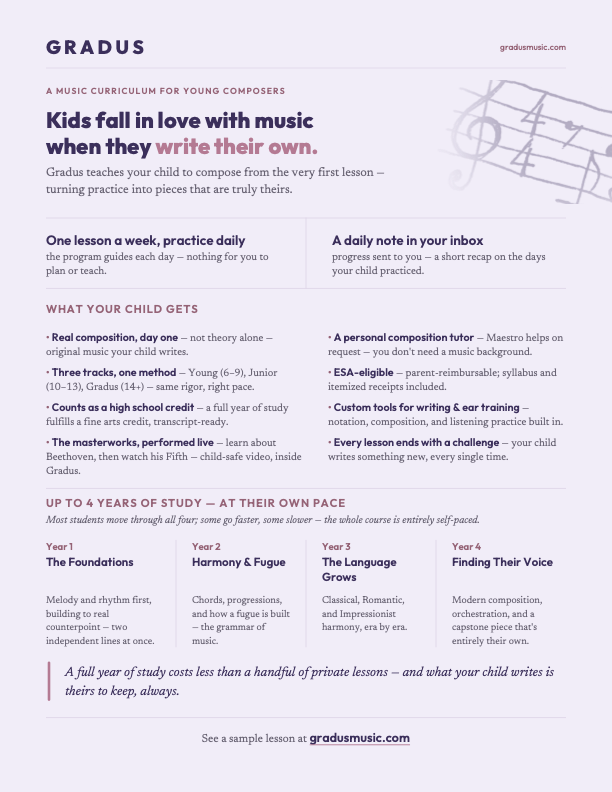
The whole curriculum on one page.
Everything above, condensed to a single sheet — the four years, the three tracks, what your child gets, and what it costs. Print it for your homeschool binder, hand it to a co-op, or send it with an ESA application.
Follow the Journey
Stay Close to the Method
New lessons, score studies, and curriculum updates — a short note now and then, as the method grows.